INDUSTRY NEWS
Advantages of Early Streamer Emission (ESE) Lightning Rods in PV and Energy Storage Projects
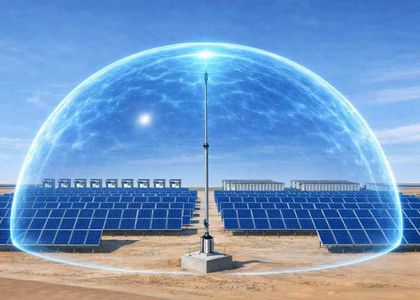
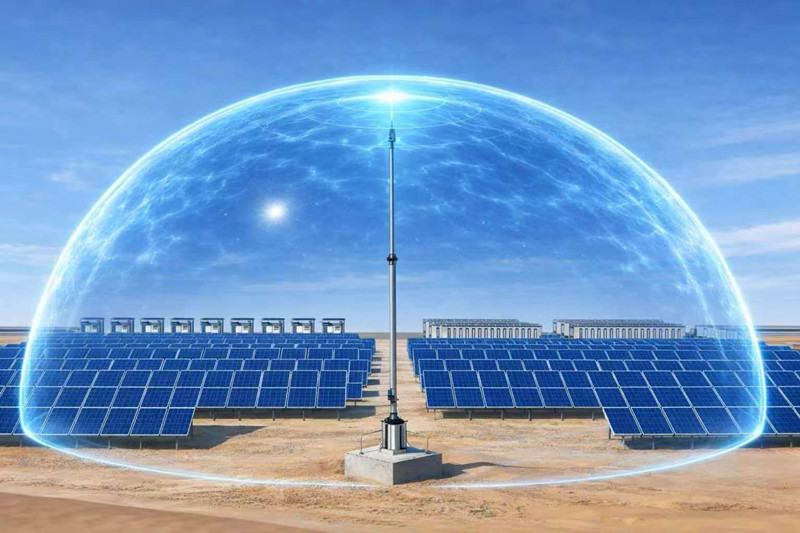
Advantages of Early Streamer Emission (ESE) Lightning Rods in PV and Energy Storage Projects
The core strengths of Early Streamer Emission (ESE) lightning rods for photovoltaic and energy storage projects lie in their large protection radius, low shielding failure rate, adaptable lifting design, compatibility with complex sites, and outstanding cost-effectiveness, making them highly suitable for lightning protection of large-scale arrays and high-value power equipment.
Core Principle
Conventional lightning rods work in a passive way to receive lightning strikes. When thunderclouds approach, ESE lightning rods actively trigger an upward streamer 25–60 microseconds in advance, taking the lead to connect with the downward leader from thunderclouds and form a targeted lightning conduction path to the ground.
Key Advantages in PV & Energy Storage Projects
1. Wide Protection Coverage for Full Array Coverage
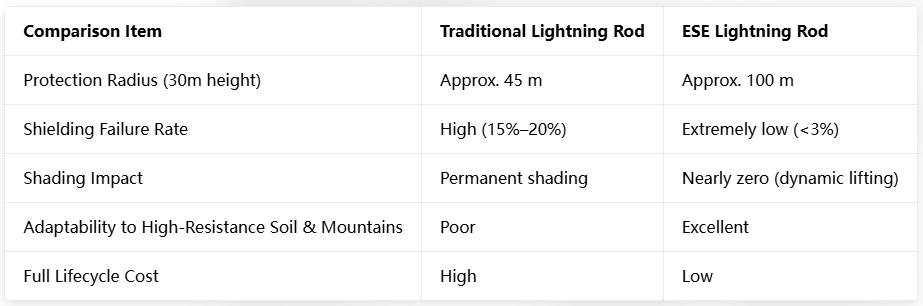
· Under the same installation height, its protection radius is 2–5 times that of traditional lightning rods, with a protection angle of 55°–65°, while traditional ones are limited to below 45°.
· For instance, a 30-meter ESE rod delivers a protection radius of 80–120 meters, compared to only 40–50 meters for conventional rods. It greatly reduces the total number of lightning rods, ideal for MW-level solar power stations and energy storage container clusters.
2. Active Lightning Interception to Avoid Shielding Failure & Side Strikes
· It establishes a priority lightning attachment channel to drastically reduce lightning bypass risks, with the shielding failure rate reduced to less than 1/5 of traditional products.
· Effectively protects high-value equipment such as energy storage batteries, inverters and junction boxes, preventing insulation breakdown, component hot spots and fire hazards caused by lightning strikes.
3. Retractable & Lifting Structure with Zero Shading Loss for Power Generation
· Linked with lightning early warning systems: the rod rises during thunderstorms and retracts to a low height of 2–3 meters in clear weather.
· Completely eliminate permanent shading from fixed tall lightning rods, boosting power generation efficiency by 2%–5%, especially for densely arranged PV arrays.
· The low-position storage design enhances wind resistance and corrosion resistance, extending service life in harsh outdoor environments.
4. Strong Adaptability to Complex Terrains & Simple Construction and Maintenance
· Suitable for areas with high soil resistivity such as mountains and deserts: the allowable grounding resistance standard is more relaxed, cutting down soil resistance reduction costs.
· Perfect for hilly and mountainous PV plants; the wide single-rod coverage avoids construction on steep slopes and rocky areas, lowering on-site construction difficulty.
· Most adopt passive and fully mechanical structures with no electronic component aging, featuring maintenance-free performance and a service life of over 25 years.
5. Excellent Economic Benefits: Low Initial Investment & Lifecycle Cost
· Lower upfront cost: The quantity of lightning rods, foundation works, down conductors and grounding grid works are reduced by 60%–80%.
· Increased revenue: Zero shading and stable operation bring an annual power generation revenue increase of 3%–8%, with the incremental cost recoverable within 1–2 years.
· Minimal operation & maintenance: Fault-free and maintenance-free design cuts annual O&M costs by nearly 90%.
Performance Comparison: ESE vs Traditional Lightning Rods
Selection & Compliance Requirements
· Applicable Standards: QX/T 106-2009, IEC 62305
· Discharge advance time options: 25/35/45/60μs, selected according to local thunderstorm days and lightning protection grade.
· Recommended linkage configuration: Atmospheric electric field monitor and lightning early warning system, with a response time of 5–15 seconds.
Summary
For large ground-mounted PV stations, mountain photovoltaics and centralized energy storage power stations, ESE lightning rods deliver comprehensive advantages in wide protection range, low lightning bypass risk, zero power generation shading, strong site adaptability and long-term cost savings. It is a high-efficiency, cost-effective and reliable upgraded solution to replace conventional lightning protection systems in new energy projects.